Choosing the best water test kit begins with understanding your water source, testing goal, and acceptable accuracy. A private well, aquarium, swimming pool, and household tap require different measurements. Testing for chlorine alone will not reveal nitrate, lead, hardness, or bacterial contamination. The right kit must match the risk.
Dr. Marc Edwards, a leading drinking-water researcher, has emphasized, “There is no safe level of lead in drinking water.” That warning makes kit selection more than a shopping decision. Look for clear detection ranges, reliable reagents, readable instructions, and independent certification. A kit with many tests may seem impressive. It may also provide shallow results. Less can be more.
Practical details matter. Check the expiration date before opening the package. Collect samples in clean containers, away from faucets with visible residue. Compare the color under natural light, not beneath a blue kitchen lamp. Record the result, time, water source, and recent plumbing changes. These small notes can reveal patterns that one test misses.
Some affordable kits offer useful screening. They cannot replace certified laboratory analysis when results appear unsafe or confusing. That limitation deserves attention. I have seen people trust a convenient strip more than a careful sampling process. That is a mistake. A strong water test kit supports informed decisions, but it does not create certainty by itself. Good testing requires suitable tools, careful handling, and a willingness to question unexpected results.
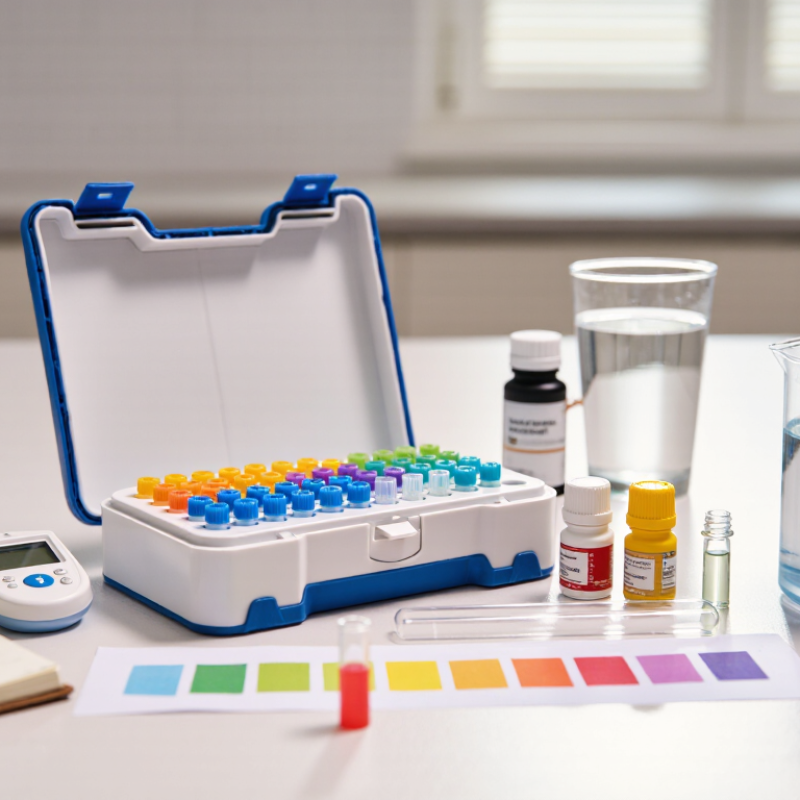
Before choosing a water test kit, define the decision it must support. Are you checking drinking-water safety, aquarium balance, pool maintenance, or irrigation conditions? Each purpose requires different measurements. A kit for household screening may test pH, chlorine, nitrate, and hardness. It may not detect bacteria, pesticides, or heavy metals.
Start with a question. “Is the water safe to drink?” is too broad. Ask whether you need to measure lead after old pipes, nitrate near farmland, or disinfectant levels after treatment. Write down the acceptable range for each result. Local health authorities and certified laboratories can provide reliable reference limits. Do not treat a color strip as a medical or legal judgment.
Sampling details matter more than many buyers expect. Use a clean container, avoid touching the inside, and test within the stated time. Record the date, source, temperature, and unusual odors. In field checks, I have seen a cloudy sample produce uncertain color readings. That result needed repeat testing. It was inconvenient, but ignoring it would have been worse.
Check the kit’s detection range, method, storage requirements, and expiration date. Look for clear instructions and controls that reveal whether the test worked. Some kits offer useful screening, not final confirmation. When results are unexpected, repeat the test and consider an accredited laboratory. A cheaper kit can become expensive when its question is poorly defined.
How to Choose the Best Water Test Kit?
The right water test kit depends on both your water source and its intended use. Tap water, private well water, rainwater, and surface water carry different risks. Drinking water needs stricter testing than water used for garden irrigation. Bathing may require attention to disinfectants, metals, and skin-irritating minerals.
For municipal tap water, check chlorine, pH, lead, copper, and nitrate. Older pipes can change the result. Private wells often need tests for bacteria, nitrate, iron, manganese, hardness, and arsenic, depending on local geology. Rainwater may require checks for acidity, turbidity, and microbial contamination. Never assume clear water is safe. It can still contain invisible hazards.
Match the kit’s detection range to the levels you expect. A test that cannot detect low concentrations offers false comfort. Select separate tests when one package lacks an important parameter. Follow sampling instructions carefully, especially flushing times and clean containers. I once overlooked the sample age, and the result became difficult to trust. Small details matter. Compare unusual findings with an accredited laboratory, particularly before changing drinking habits or treating a private source. Record the date, weather, source, and intended use beside every result. This simple habit can reveal seasonal changes that a single test misses.
| Water Source | Intended Use | Priority Test Parameters | Recommended Kit Type | Useful Measurement Range | Why These Tests Matter | Testing Priority |
|---|---|---|---|---|---|---|
| Municipal tap water | Drinking and cooking | Free chlorine, pH, lead, copper, nitrate/nitrite, hardness | Multi-parameter kit plus laboratory confirmation for metals | pH 6.5–8.5; free chlorine 0–4 mg/L; nitrate as nitrogen 0–10 mg/L | Disinfectant levels can affect taste and odor. Lead and copper may enter water from household plumbing, while nitrate is especially important where contamination risks exist. | Routine |
| Private well water | Drinking and household use | Total coliform bacteria, E. coli, nitrate/nitrite, pH, arsenic, lead, manganese, iron, hardness | Comprehensive screening kit with accredited laboratory follow-up | pH 6.5–8.5; nitrate as nitrogen 0–10 mg/L; metals according to laboratory detection limits | Private wells are not regulated like public water systems. Bacterial contamination and naturally occurring or site-related chemicals can vary after flooding, repairs, or changes in land use. | High priority |
| Rainwater collection | Garden irrigation | pH, electrical conductivity, total dissolved solids, nitrate, bacteria when used on edible crops | Digital TDS/EC meter plus targeted chemical and microbiological tests | pH 5.5–8.5; EC 0–1.5 mS/cm for general irrigation screening | Roof materials, dust, bird waste, and storage conditions can change water quality. Salts and microbes may affect plants and produce safety. | Periodic |
| Rainwater collection | Toilet flushing or laundry | pH, turbidity, total coliform bacteria, E. coli, TDS, color and odor | Basic physical and microbiological kit with laboratory verification where required | Turbidity below 5 NTU is a practical screening target; bacterial limits depend on local regulations | Stored rainwater can support microbial growth and accumulate particles. It should not be assumed safe for drinking without appropriate treatment and verification. | High priority |
| Aquarium water | Freshwater fish and plants | Ammonia, nitrite, nitrate, pH, carbonate hardness, general hardness, temperature | Liquid drop-count kit or aquarium-specific multi-test kit | Ammonia 0 mg/L; nitrite 0 mg/L; nitrate commonly below 20–40 mg/L, depending on species | Ammonia and nitrite are toxic to fish, especially when pH and temperature increase. Suitable hardness and pH depend on the species being kept. | High priority |
| Swimming pool | Recreational use | Free chlorine, combined chlorine, pH, total alkalinity, calcium hardness, cyanuric acid | DPD chlorine test kit with pH and alkalinity tests | Free chlorine commonly 1–4 mg/L; pH 7.2–7.8; alkalinity often 80–120 mg/L as CaCO3 | Disinfectant and pH balance influence pathogen control, swimmer comfort, corrosion, and scale formation. Target values vary with the disinfection system and local guidance. | High priority |
| Hot tub or spa | Frequent recreational use | Free chlorine or bromine, pH, total alkalinity, calcium hardness, combined chlorine | High-resolution sanitizer and pH test kit | Free chlorine commonly 3–5 mg/L; bromine commonly 4–6 mg/L; pH 7.2–7.8 | Warm water can accelerate microbial growth and chemical reactions. Testing before use and regularly during operation is more important than occasional testing. | High priority |
| Aquaculture or pond water | Fish and aquatic organisms | Dissolved oxygen, temperature, pH, ammonia, nitrite, nitrate, alkalinity, salinity where relevant | Field kit with a dissolved oxygen meter and separate nutrient tests | Dissolved oxygen generally above 5 mg/L for many fish; ammonia and nitrite should be kept as low as possible | Oxygen and toxic nitrogen compounds can change quickly with stocking density, feeding, temperature, and biological activity. | High priority |
| Bottled or filtered drinking water | Drinking and taste monitoring | TDS, pH, hardness, nitrate, residual disinfectant where applicable | Basic meter for routine checks plus laboratory testing for contaminant concerns | TDS commonly 50–500 mg/L, although acceptable values vary by source and treatment | TDS and hardness help identify changes in mineral content but do not prove that water is microbiologically or chemically safe. | Periodic |
| Water treated by reverse osmosis | Drinking water system monitoring | TDS, conductivity, pH, nitrate, and targeted contaminants based on the source water | Digital TDS/conductivity meter with periodic laboratory testing | Compare feed-water and product-water readings; a substantial increase in product TDS may indicate membrane or maintenance issues | TDS and conductivity can reveal performance changes, but they cannot detect every contaminant. Filter age, storage, and sanitation also affect results. | Routine |
| Agricultural irrigation water | Crop irrigation | EC, TDS, pH, sodium, chloride, bicarbonate, boron, nitrate, alkalinity | Laboratory soil-and-water analysis plus field EC/pH meter | EC below 0.7 dS/m is generally low salinity; crop tolerance varies widely | Salinity, sodium, chloride, and boron can reduce plant growth or damage soil structure. Interpretation should consider crop type, soil, and irrigation method. | Seasonal |
| Construction or process water | Concrete mixing or industrial use | pH, TDS, chloride, sulfate, alkalinity, suspended solids, oil and grease where relevant | Application-specific laboratory test panel | Limits depend on the material specification, process, and applicable standard | Chloride, sulfate, dissolved solids, and organic contamination may affect concrete performance, equipment, product quality, or wastewater compliance. | High priority |
Choosing the best water test kit depends on the result you need, not its appearance.
Test strips are fast and convenient for routine checks.
However, color blocks can be difficult to match under weak kitchen lighting.
Liquid reagent kits usually provide clearer color changes and broader detection ranges. They require careful measuring and clean glassware. Digital meters can offer precise readings, especially for pH or conductivity. Yet they need calibration, battery care, and regular electrode cleaning.
Accuracy also depends on the target substance and its expected level.
A kit designed for trace nitrate may not detect unusually high concentrations reliably. Check the lowest and highest readable values before buying. Compare the stated accuracy with your testing purpose.
For drinking water screening, small differences may matter. For a fish tank, stable trends can be more useful than one exact number.
I once recorded a strange result because the sample container still held cleaning residue. Simple mistakes happen.
Tips:
Test at the same time of day when possible.
Rinse containers with the sample first.
Read colors in natural, indirect light.
Keep reagents sealed and check expiry dates.
For digital tools, calibrate them as instructed.
Record the date, temperature, and result.
If a reading seems unusual, test again with a fresh sample. One result should invite reflection, not immediate certainty.
A reliable water test kit should feel complete before the first sample is opened. Check the seal, instruction clarity, testing range, and expiration dates. Reagents should have visible batch information and stable color indicators. A clear comparison chart helps prevent misreading. During routine checks, I prefer kits with simple steps and consistent timing. Complicated procedures invite mistakes, especially when testing several samples after a long day.
Storage requirements matter more than many buyers expect. Some reagents need a cool, dry cabinet away from sunlight. Others must remain tightly closed because humidity can weaken the powder. Never leave the kit beside a sink or in a hot vehicle. Check whether the container needs refrigeration, but do not assume colder is always safer. I once stored a testing solution near a window and noticed unreliable readings later. That error was avoidable.
Cost should include replacement supplies, not only the initial box. Calculate the price per test and check whether individual reagents, test strips, sample cups, and measuring tools are sold separately. A low-cost kit becomes inconvenient when one missing component requires replacing everything. Look for replacement supplies with matching instructions and compatible concentrations. Keep a simple usage log. It reveals which items run out fastest, although my own records are not always perfect.
How to Choose the Best Water Test Kit?
A reliable kit begins with disciplined sampling, not attractive packaging. In 2022, 2.2 billion people lacked safely managed drinking water, according to the WHO/UNICEF Joint Monitoring Programme 2023 report. That figure makes careful testing more than a household exercise. It becomes a small quality-control procedure.
Use a sterile container and avoid touching its inside or lid. Let the cold tap run for two to five minutes, unless the instructions specify otherwise. Collect the sample without splashing. Record the date, time, location, water temperature, and recent plumbing activity. Test promptly, because heat and sunlight can change microbial results. The World Health Organization recommends no detectable E. coli in any 100-millilitre drinking-water sample. However, a color strip cannot confirm every contaminant. That limitation is easy to forget.
Tips: Follow the kit’s holding time exactly. Check the expiry date. For metals, collect both first-draw and flushed samples when possible. A first-draw sample may reveal plumbing-related exposure, while a flushed sample better represents incoming water. Compare unusual results with a certified laboratory using approved methods. One unexpected result deserves a repeat test, not immediate panic. My own weak point would be trusting a single reading too quickly. Results can reflect sampling error, contamination, or real change. Keep the records. Patterns often explain what one test cannot.